(通讯员:李紫霖)为深化《中国文化概要》课程实践教学,推动荆楚优秀传统文化国际传播,搭建中外青年跨文化思辨与比较研读平台,外国语学院组织 24 级英语专业 6 名学生,与加拿大温莎大学语言与文化系 2 名学生组成研讨小组,开展首次线上文学研讨。中外组员跨越时差,以楚辞《九歌》为核心文本,围绕古典神话、诗歌意象展开深度对话,在东西方文学互鉴中讲述楚文化故事。
正式研讨前,双方小组于 10 月 26 日开展线上测试会议,完成前期对接磨合。会上,组员逐一自我介绍,测试音视频、屏幕共享、举手互动等功能;我方学生围绕武汉城市文化进行简短试分享,温莎大学组员即时反馈,共同确定交流规范、发言次序与研讨流程,为本次首次研讨做好技术筹备。
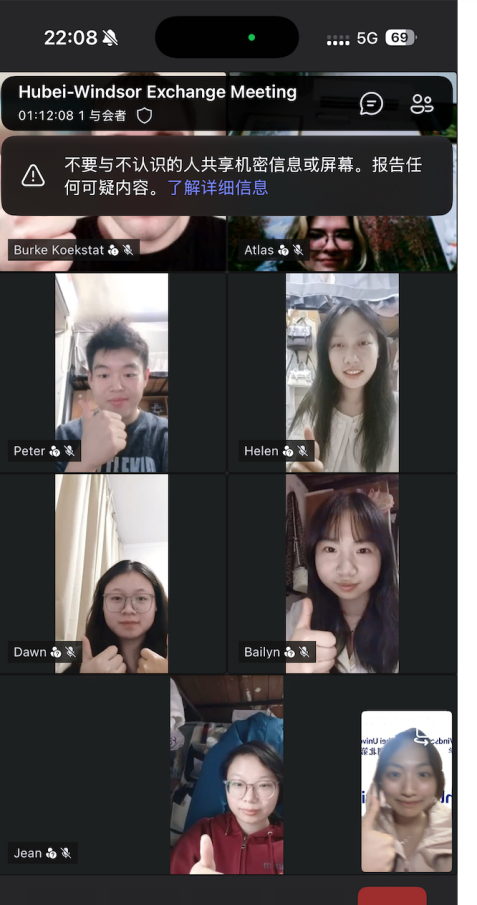
11 月 6 日晚,该中加联合小组的首场线上研讨正式开启,本次活动以中国楚辞《九歌》与古希腊神话、诗歌作为核心议题。我方小组作为主讲方,依次介绍《九歌》的祭祀文学背景,讲解湘君、大司命两位神祇的形象与内涵:湘君作为湘水之神,与湘夫人构成双向思念的对偶神祇;大司命执掌人间寿夭命运,承载着中国上古独特的天命观念。每一部分分享结束后,我方主动开放交流,邀请加拿大同学提问、交流看法。
温莎大学的Atlas、Burke等同学结合古希腊神话体系展开精彩回应与对比,带来富有启发性的文学观察。围绕湘君这一位河神,他们对比古希腊河神“Potamos”的性别传统,梳理希腊罗马文学里河神、河宁芙形象的流变;同时以阿里阿德涅与忒修斯的经典神话为例,剖析古希腊诗歌里常见的“遗弃、分离”文学母题。双方进一步探讨两类神话体系中人神爱恋关系的差异:古希腊神话中的人神故事大多呈现权力不对等的关系,多为男神与凡间女子相恋;而《九歌》里湘君与湘夫人同为神灵,二者之间是平等、相互惦念的关系,这也是东方古典文学极具特色之处。
我方同学也主动抛出问题,与对方深入交流,探讨宙斯形象、古希腊神界男女神祇之间的权力关系,以及古希腊众神是否以现实人类社会作为原型。双方发现,古希腊神话很大程度上是当时现实社会秩序的投射;而《九歌》根植于楚地祭祀文化,寄托着古人对生命、命运与情感的想象,两套古老的文学体系既有可以呼应的文学母题,又生长出截然不同的文化气质。
本次线上交流虽有时差阻隔,会议途中也出现设备、网络等小插曲,但双方青年始终耐心倾听、积极表达。交流尾声,大家一同截屏留念,并约定持续通过邮件交流想法。
本次跨洋研讨是富有实效的跨文化课程实践。同学们以英文为载体,向外阐释楚辞经典,同时近距离感知西方古典文学,在比较思辨中拓展国际视野,提升跨文化沟通能力。活动紧扣《中国文化概要》全英文教学与地域文化传播目标,以楚文化经典为纽带,搭建中外青年平等对话的桥梁,推动中华优秀传统文化对外阐释,实现文明互鉴。双方组员均期待以小组为单位推进后续主题交流,让古老诗歌跨越山海,在青年持续对话中焕发新的活力。
Poetry as a Bridge, Dialogue Across the Ocean: Tracing the Literary Tradition of the “Nine Songs”, Conveying the Elegance of Jingchu Culture — The School of Foreign Languages Holds an Online Literary Seminar with the Department of Language, Literature and Culture of the University of Windsor
(Contributor: Li Zilin) To deepen the practical teaching of the course “An Overview of Chinese Culture”, promote the international dissemination of outstanding traditional Jingchu culture, and build a platform for cross-cultural critical thinking and comparative reading among Chinese and foreign collage students, the School of Foreign Languages organized six English majors from the Class of 2024, together with two students from the Department of Language and Culture at the University of Windsor, Canada, to form joint discussion groups and hold their first online literary seminar. Crossing time zones, the Chinese and Canadian members engaged in in-depth dialogue centered on the “Nine Songs” of the “Chu Ci” (Songs of Chu), focusing on classical mythology and poetic imagery, telling the story of Chu culture through mutual appreciation of Eastern and Western literature.
Before the formal seminar, the two groups held an online test meeting on October 26 to complete preliminary coordination and preparation. During the meeting, members introduced themselves one by one and tested functions such as audio and video, screen sharing, and the “raise hand” interaction feature. Our students gave a brief trial presentation on Wuhan’s urban culture, which received immediate feedback from the Windsor members. Together, they established communication norms, speaking order, and the seminar procedure, completing the technical preparations for this first discussion.
On the evening of November 6, the first online seminar of the China–Canada joint group officially began. The seminar centered on the “Nine Songs” of the “Chu Ci” and ancient Greek mythology and poetry as its core topics. Our group, as the main presenters, introduced the sacrificial-literary background of the “Nine Songs” in sequence and explained the images and meanings of two deities, Xiang Jun and Da Siming: Xiang Jun, as the god of the Xiang River, forms a pair with Xiang Fu Ren in a relationship of mutual longing; Da Siming presides over human lifespans and carries the unique ancient Chinese notion of Heaven’s mandate. After each presentation, our students actively opened discussions, inviting the Canadian students to ask questions and share their views.
Students from the University of Windsor, Atlas and Burke, responded with insightful comparisons drawing on the ancient Greek mythological system, offering inspiring literary observations. Regarding Xiang Jun as a river god, they compared the gender traditions of the ancient Greek river god “Potamos” and traced the evolution of river gods and river nymphs in Greco-Roman literature. Using the classic myth of Ariadne and Theseus as an example, they also analyzed the recurring literary motif of “abandonment and separation” in ancient Greek poetry. The two sides further explored the differences in human–deity romantic relationships between the two mythological systems: in ancient Greek mythology, such stories mostly reflect unequal power dynamics, typically between male gods and mortal women, whereas in the “Nine Songs”, Xiang Jun and Xiang Fu Ren are both deities whose relationship is one of equality and mutual devotion—a distinctive feature of classical Eastern literature.
Our students also raised questions of their own, engaging in in-depth exchanges on the figure of Zeus, the power relations between male and female deities in the ancient Greek pantheon, and whether the Greek gods were modeled on real human society. Both sides discovered that ancient Greek mythology was largely a projection of the social order of its time, while the “Nine Songs” is rooted in the sacrificial culture of the Chu region, embodying ancient people’s imagination of life, fate, and emotion. These two ancient literary systems share resonant motifs while having developed markedly different cultural temperaments.
Despite the time difference and minor technical and network glitches during the meeting, the young participants from both sides remained patient listeners and active speakers throughout. At the close of the exchange, everyone took a group screenshot as a memento and agreed to continue exchanging ideas via email.
This transoceanic seminar proved to be a highly effective cross-cultural course practice. Using English as the medium, students interpreted the classics of the “Chu Ci” for an international audience while gaining firsthand insight into Western classical literature, broadening their global perspectives and enhancing their cross-cultural communication skills through comparative critical thinking. Aligned with the goals of the all-English instruction of “An Overview of Chinese Culture” and regional cultural dissemination, the event used the classics of Chu culture as a bond to build a bridge of equal dialogue between Chinese and foreign youth, promoting international interpretation of excellent traditional Chinese culture and achieving mutual learning among civilizations. Members of both groups look forward to advancing further themed exchanges as groups, allowing ancient poetry to cross mountains and seas and gain renewed vitality through the continued dialogue of young people.