(通讯员 周群英)为深化课程实践教学,持续推进跨文化交流实践,推动荆楚优秀传统文化国际传播,依托我院教师获批的国家留学基金委地方合作项目赴加拿大温莎大学访学的契机,外国语学院24级英语3班小组于11月11日、11月21日,与温莎大学两名研习希腊罗马神话的学生开展两轮递进式线上跨国研讨。
本次活动是《中国文化概要(英)》课程系列实践项目,以屈原《九歌·东君》为核心,围绕中国上古日神形象展开跨文化对话。在11月11日的首轮研讨中,我方小组作为主讲人,向海外伙伴介绍《九歌》是屈原在楚地民间祭歌基础上加工创作的祭祀乐歌,细致解读《东君》篇中日神形象、祭祀场景与浪漫的楚地巫祭文化,阐释东君作为日神承载着古人对光明、时序的敬畏,以及祈愿安宁顺遂的美好寄托,厘清东君的祭祀属性,区分其与世俗抒情诗歌的不同。互动问答环节,温莎大学同学围绕东君的神性特质、祭祀仪式、文本意象等提出诸多疑问。双方还初步将中国日神东君与希腊日神阿波罗展开对比,辨析二者文化底色:东君根植于楚地集体祭祀文化,庄重且与天地时序紧密相连;阿波罗是高度人格化的希腊神祇,常与光明、艺术、预言等多重职能相关联。首轮交流结束后,我方认真梳理外方同学提出的疑问与关注点,针对讲解内容、案例阐释、文化对比维度开展修改完善,并经过10天的打磨优化,为第二轮深度研讨做好充分准备。
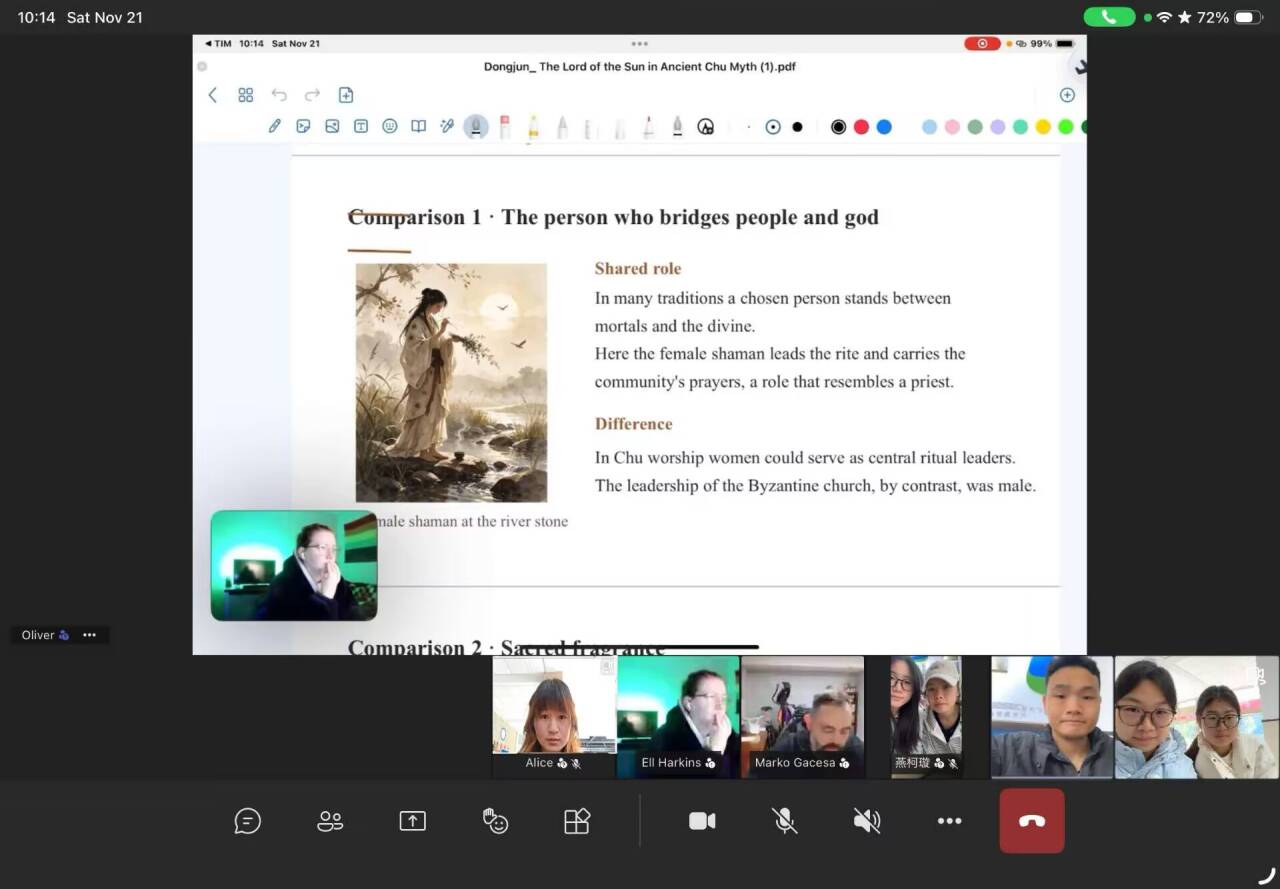
11月21日,第二轮线上研讨如期举行,本次研讨由访学教师牵线对接。本次交流聚焦首轮研讨遗留的问题逐一回应,结合优化后的材料,进一步对东君的祭祀内涵、意象符号、仪式背景做更为详实的阐释。双方进一步拓展中西神话对比维度,从祭祀礼俗、精神内核、文学意象等层面展开更细致的对话,对比分析楚地祭祀文化与古希腊神话体系的差异。中方向外方讲解中国上古神话敬畏天地、集体祈福的精神特质;外方也分享希腊罗马神话体系下神祇人格化塑造的文化逻辑。针对酒、祭祀供品等仪式象征意象,双方还就中西方祭祀传统进行延伸交流,在一问一答的思辨之中消除文化认知偏差。
两轮研讨形成了层层深入的跨文化对话闭环。从初次介绍解读,到复盘修改、深度辨析,同学们不断打磨英文表达,锻炼英文阐释、逻辑思辨、跨文化沟通与临场应答能力。同学们在双向交流中向外讲好中国古典神话故事,在文明对照中客观理解中西方文化差异,提升了用英文阐释中华经典的能力,进一步夯实文化自信。
学院表示,后续将持续搭建国际交流实践平台,以课程实践为抓手,以楚文化经典为纽带,搭建中外青年平等对话的桥梁,培养兼具深厚中华文化底蕴与国际视野的外语师范人才。
Bridging Cultures Through Poetry: A Cross-Ocean Dialogue — Tracing the Literary Heritage of the“Nine Songs”and Conveying the Elegance of Jingchu Culture
The School of Foreign Languages and the Department of Language, Literature and Culture at the University of Windsor Hold Online Literary Seminar (SessionIII): “The Lord of the East” from the “Nine Songs”
(Correspondent: Zhou Qunying) To deepen curriculum-based teaching practice, continuously advance cross-cultural exchange activities, and promote the international dissemination of the outstanding traditional culture of Jingchu (Hubei-Hunan region), leveraging the opportunity provided by the China Scholarship Council’s Regional Cooperation Program, under which a faculty member of the School of Foreign Languages is going to conduct visiting research at the University of Windsor in Canada, a student group from English Class 3, Grade 2024 of the School of Foreign Languages held two progressively structured online international seminars with two University of Windsor students studying Greek and Roman mythology on November 11 and November 21.
This activity is part of the practical project series of the course “An Overview of Chinese Culture (in English)”, centering on “The Lord of the East” from the “Nine Songs” by Qu Yuan, and engaging in cross-cultural dialogue centered on the image of the ancient Chinese sun god. In the first seminar on November 11, the Chinese group, serving as the main presenters, introduced to their overseas partners that the “Nine Songs” are ritual songs and hymns which Qu Yuan adapted and refined from folk sacrificial songs of the Chu region. They offered a detailed interpretation of the sun god’s image, the sacrificial scenes, and the romantic shamanistic sacrificial culture of Chu as depicted in “The Lord of the East”, explaining that Dongjun (the Lord of the East), as the sun deity, embodies the ancient people’s reverence for light and the order of time, as well as their beautiful aspirations for peace and prosperity. They also clarified Dongjun’s ritual and sacrificial attributes, distinguishing this work from secular lyric poetry.
During the Q&A session, the University of Windsor students raised many questions regarding Dongjun’s divine nature, sacrificial rituals, and textual imagery. The two sides also began a preliminary comparison between the Chinese sun god Dongjun and the Greek sun god Apollo, analyzing their differing cultural foundations: Dongjun is rooted in the collective sacrificial culture of the Chu region, solemn and closely connected to the order of heaven, earth, and time, while Apollo is a highly personified Greek deity often associated with multiple functions such as light, art, and prophecy.
After the first round of exchange, the Chinese group carefully reviewed the questions and points of interest raised by their foreign counterparts, refined and improved their presentation content, illustrative examples, and dimensions of cultural comparison, and spent ten days polishing and optimizing their materials in preparation for the second in-depth seminar.
On November 21, the second online seminar was held as scheduled, with the visiting faculty member facilitating the connection. This session focused on responding one by one to the questions left over from the first round. Drawing on the optimized materials, the Chinese side provided more detailed explanations of Dongjun’s sacrificial connotations, symbolic imagery, and ritual background. The two sides further expanded the dimensions of comparison between Chinese and Western mythology, engaging in more nuanced dialogue on levels such as sacrificial customs, spiritual essence, and literary imagery, and analyzing the differences between the sacrificial culture of the Chu region and the ancient Greek mythological system. The Chinese side explained to the foreign side the spiritual characteristics of ancient Chinese mythology—reverence for heaven and earth and collective prayer for blessings—while the foreign side shared the cultural logic underlying the personification of deities in the Greek and Roman mythological systems. Regarding ritual and symbolic imagery such as wine and sacrificial offerings, the two sides also extended their exchange to Chinese and Western sacrificial traditions, dispelling cultural misconceptions through question-and-answer-based critical dialogue.
The two rounds of seminars formed a progressively deepening closed loop of cross-cultural dialogue. From initial introduction and interpretation, to review and revision, and then to in-depth analysis, the students continuously refined their English expression, exercising their abilities in English exposition, logical thinking, cross-cultural communication, and impromptu response. Through two-way exchange, the students told stories of classical Chinese mythology to the world, objectively understood the differences between Chinese and Western cultures through civilizational comparison, enhanced their ability to interpret Chinese classics in English, and further strengthened their cultural confidence.
The School stated that it will continue to build platforms for international exchange and practice, using curriculum practice as a lever and classics of Chu culture as a bond, constructing a bridge of equal dialogue between Chinese and foreign youth, and cultivating foreign language students who possess both profound Chinese cultural grounding and an international vision.